PE vs PVC Christmas Trees for Manufacturers: Equipment, Materials, Cost, and How to Choose

If you are planning a Christmas tree production line, the biggest early decision is usually not branding or packaging. It is whether you are building around PE Christmas trees, PVC Christmas trees, or a hybrid structure that uses both.
That choice affects almost everything downstream: the materials you buy, the machines you install, the labor you need, the type of customers you can serve, and the margin structure you can realistically protect. A factory that chooses the wrong production route can end up with the wrong equipment mix, weak pricing power, or a product that does not match its target market.
This guide explains the real manufacturing difference between PE vs PVC Christmas trees. We will compare appearance, equipment, materials, labor, tooling investment, unit economics, and buyer positioning so you can decide which production model makes the most sense for your factory.
Quick Answer: PE vs PVC Christmas Trees
For most manufacturers, the short answer looks like this:
- Choose PVC Christmas trees when you need lower startup cost, faster product development, flexible SKU changes, and stronger fit for entry-level or mid-market programs.
- Choose PE Christmas trees when you want a more realistic look, stronger premium positioning, and the margin potential to justify mold and equipment investment.
- Choose a hybrid PE/PVC structure when you want to balance appearance and cost by using PE tips on visible outer sections and PVC branches deeper inside the tree.
If your team is still deciding how PVC material supply fits into that choice, it helps to review this separate PVC Christmas tree film buyer’s guide alongside the manufacturing decision.

What PE and PVC Christmas Trees Actually Mean in Production
From a manufacturing point of view, PE and PVC do not just describe two materials. They describe two different production systems.
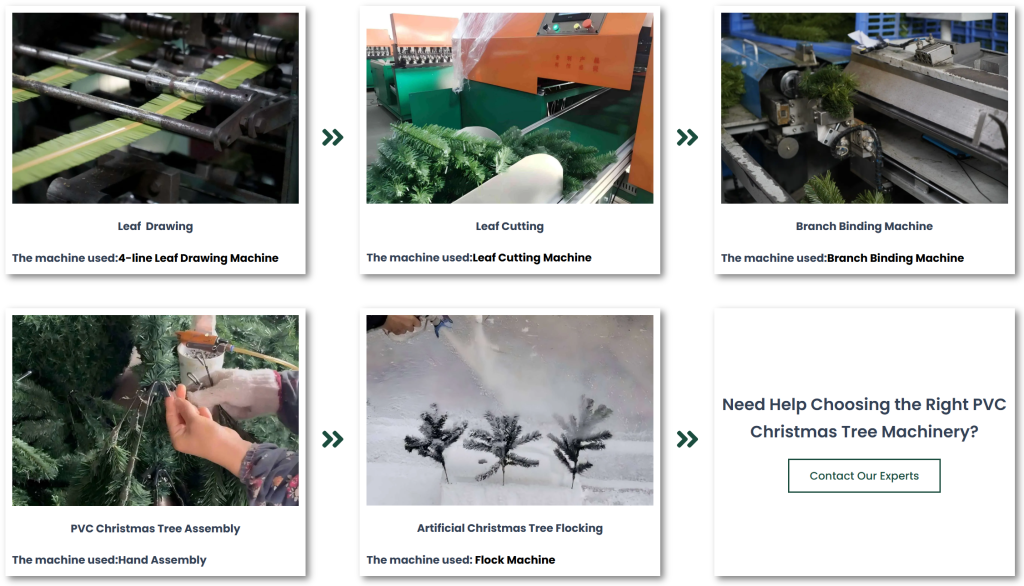
PVC Christmas trees are usually built from cut or drawn PVC film that becomes branch leaves. Those leaves are wrapped or bound onto wire branches, assembled onto hubs or poles, and then shaped into finished trees. The production line depends heavily on film preparation, leaf cutting, branch binding, and final assembly.
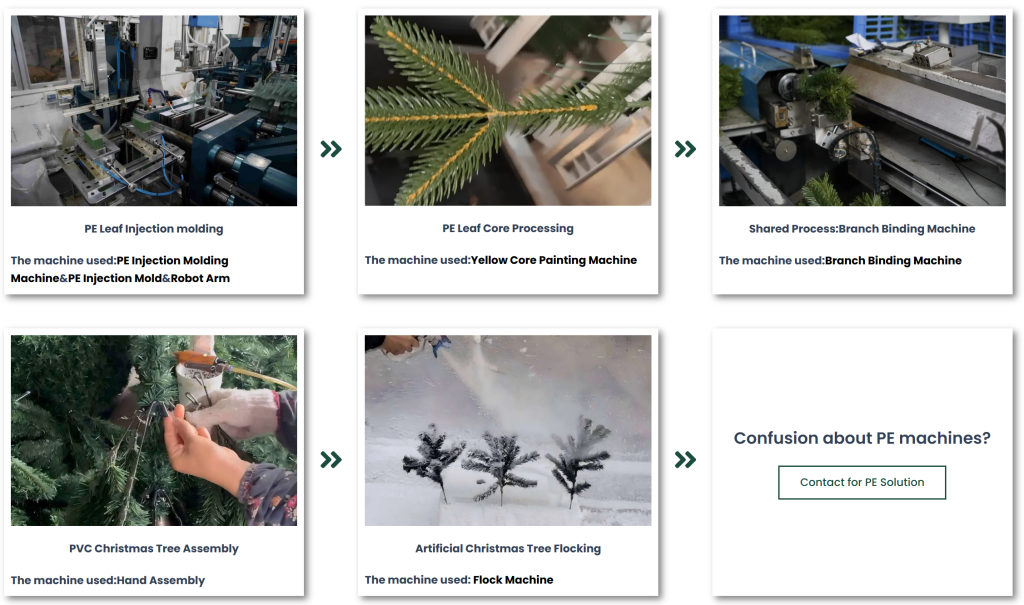
PE Christmas trees rely more on injection molding. The needles or branch tips are formed through PE molds, then combined with wire cores and assembled into branch structures. This route requires a different equipment profile, more tooling investment, and tighter planning around molds, cycle time, and output consistency.
That is why PE vs PVC Christmas trees is not just a product-design question. It is a factory-layout and capital-allocation question.
Appearance and Market Positioning
The most obvious difference between PE vs PVC Christmas trees is visual realism.
PE trees usually offer a more natural, molded needle look. That makes them easier to position as premium products, especially in markets where consumers want a fuller and more realistic artificial tree. If your customers sell into higher-end retail, export programs, or private-label premium lines, PE often gives you a stronger visual story.
PVC trees usually look more traditional and are often easier to position in value or mainstream price bands. That does not make them low quality by default. A well-made PVC tree can still sell very well, especially when shape, density, and color consistency are strong. But in most direct side-by-side comparisons, PE wins on realism.
For many factories, this is the practical rule:
- PE supports a higher-end product promise.
- PVC supports a more cost-efficient product strategy.
- Hybrid trees give you a middle ground.
If you want a broader view of how finished tree types are commonly categorized, see classification of artificial Christmas trees.

Material Inputs: PVC Film vs PE Pellets
The material side of the decision is one of the clearest differences between PE vs PVC Christmas trees.
PVC Material Model
PVC tree production usually begins with PVC film. Factories need the right film thickness, color, embossing, and slitting compatibility because these determine how well the leaves draw, cut, bind, and hold shape.
That means the material conversation is often about:
- film specification
- color consistency
- embossing pattern
- roll handling
- branch-leaf forming compatibility
If you are evaluating this route, the dedicated PVC Christmas tree film buyer’s guide is the most useful supporting resource.
PE Material Model
PE tree production depends more on resin handling. Instead of starting with film rolls, you are typically planning around pellets, mold design, machine setup, and molded-tip consistency.
That changes the procurement conversation. PE buyers often need to confirm:
- pellet grade stability
- molding behavior
- color consistency
- compatibility with molds and injection settings
- surface finish after molding
This is why the separate PE pellets for artificial Christmas trees article is important if you are leaning toward PE production.
Equipment Difference: Two Very Different Production Lines
The equipment gap is where many factory decisions become clearer.
PVC Christmas Tree Equipment Route
A PVC-oriented factory usually needs equipment for:
- film handling
- leaf drawing or cutting
- branch binding
- trunk and branch assembly
- shaping and packing
In other words, the PVC route is a converting-and-assembly route. The machinery set is usually easier to phase in gradually, and SKU changes are often easier to manage because you are not locked into mold tooling in the same way.
PE Christmas Tree Equipment Route
A PE-oriented factory usually needs equipment for:
- resin feeding
- injection molding
- molds
- molded tip handling
- branch-core integration
- downstream assembly
This route is more tooling-intensive and process-sensitive. Once you commit to PE production, machine utilization, mold planning, cycle time, and maintenance discipline matter much more.
Why This Matters for Factory Planning
When buyers compare PE vs PVC Christmas trees, they sometimes focus too much on the finished product and not enough on the production burden. But from a management perspective, the question is really:
- Which machine family fits our factory?
- Which production bottlenecks can we manage?
- Where do we want to spend capital: on molds or on flexible material conversion?
If you are planning line structure rather than just one product, this article on how to build an efficient artificial Christmas tree production line from scratch is a useful companion read.
Startup Cost and Tooling Investment
This is where PVC usually has the clearest advantage.
For a new or expanding factory, PVC Christmas tree production is often easier to start because it does not require the same mold investment profile as PE. You still need the right machines and material quality, but the capital burden is usually lighter and the line is easier to adjust when customer requirements change.
PE production typically demands higher upfront spending because molds and injection-related equipment drive cost before output even stabilizes. If you are producing for a narrow product range at high volume, that can make sense. If you expect frequent design changes, smaller order runs, or mixed export requirements, that investment can become harder to recover quickly.
This is why PE vs PVC is often not just a material decision. It is a risk decision:
- PVC lowers the barrier to entry and usually lowers redesign risk.
- PE raises the barrier to entry but can improve premium product value.
Labor and Process Complexity
The labor conversation is more nuanced than many buyers expect.
PVC production often uses more converting and assembly steps, which means labor efficiency depends heavily on branch binding, cutting consistency, and how much of the line has been automated. A manual-heavy PVC factory can see labor pressure quickly, especially during peak season.
PE production may reduce some types of manual finishing at the needle-formation stage, but it introduces its own complexity in mold setup, machine handling, and technical operation. So PE is not automatically “low labor.” It is often more technically demanding labor.
That is why the right question is not:
Which one uses less labor?
The better question is:
Which labor model fits our factory best?
If labor cost is already one of your bottlenecks, these two related guides are especially relevant:
Unit Cost, Margin, and Selling Strategy
In most factory scenarios, PVC trees are easier to position as cost-efficient products, while PE trees are easier to position as premium products.
That does not automatically mean PE gives better margins. Higher selling price only helps if your market truly pays for realism and if your tooling and production costs are managed well. Likewise, PVC can still be highly profitable if your factory controls material usage, labor, and SKU efficiency.
A practical way to think about it:
PVC Margin Logic
- lower startup cost
- easier SKU variation
- strong fit for cost-sensitive programs
- margin depends on throughput discipline and labor control
PE Margin Logic
- higher selling-price potential
- stronger premium positioning
- margin depends on tooling utilization, machine efficiency, and stable volume
Hybrid Margin Logic
- good compromise between premium appearance and cost control
- often attractive for buyers who want a more realistic tree without going fully PE
For many manufacturers, hybrid production is the most commercially practical answer because it keeps premium visual impact on the outside while controlling material and equipment burden on the inside.
PE vs PVC Christmas Trees: Side-by-Side Manufacturing Comparison
Here is a simplified factory-level comparison:
| Factor | PVC Christmas Trees | PE Christmas Trees |
|---|---|---|
| Appearance | Traditional, less realistic | More realistic, molded-needle look |
| Startup Cost | Lower | Higher |
| Tooling Investment | Lower | Higher because of molds |
| SKU Flexibility | Higher | Lower once molds are fixed |
| Material Input | PVC film | PE pellets + molds |
| Production Model | Converting + binding + assembly | Injection molding + assembly |
| Premium Positioning | Medium | Stronger |
| Entry-Level Fit | Strong | Weaker |
| Hybrid Compatibility | Strong | Strong |
This is the core reason the page is ranking for PE vs PVC Christmas trees: buyers are not only comparing materials. They are comparing business models.
When PVC Is the Better Manufacturing Choice
PVC is usually the better route when:
- you want lower entry cost
- you need flexible product development
- you expect frequent SKU changes
- your target market is cost-sensitive
- you want a simpler path into Christmas tree manufacturing
PVC also makes sense when you already have converting and branch assembly strength in-house and do not want to shift heavily into mold-based production.
If your factory is currently deciding how to structure a PVC-focused setup, this article on how to choose the PVC Christmas tree production equipment that suits you is worth reviewing next.
When PE Is the Better Manufacturing Choice
PE is usually the better route when:
- your customers want higher realism
- you are serving premium retail or export programs
- your expected volume can justify molds and equipment
- you want stronger perceived product value
- your factory can manage more technical production control
PE also becomes more attractive when your business is less dependent on rapid SKU variation and more dependent on strong repeat programs built around stable molded designs.
When a Hybrid Tree Makes More Sense Than Either Extreme
Many factories do not need to choose a pure PE or pure PVC model. A hybrid tree often offers the best commercial balance.
In a hybrid structure, visible outer branch tips may use PE for realism, while inner layers use PVC to manage cost. That can improve the shelf look without pushing the full production line into a fully PE cost structure.
For many buyers, the hybrid route is where the smartest compromise happens:
- better appearance than standard PVC
- lower cost than full PE
- broader product-market fit
If your factory serves multiple customer tiers, hybrid production can also make your catalog easier to segment into value, mid-range, and premium programs.
Common Mistakes When Choosing Between PE and PVC
Factories usually make one of these mistakes:
Mistake 1: Deciding only from consumer appearance
Yes, PE often looks better. But if your machinery, labor, mold budget, and expected volume do not support it, a visually better product may still be the wrong business choice.
Mistake 2: Choosing only by material cost
Lower material cost does not automatically mean better margins. Labor, scrap, machine utilization, and finished-market positioning matter too.
Mistake 3: Ignoring product-line strategy
If your customers span multiple price bands, the best answer may be a hybrid portfolio instead of one single material route.
Mistake 4: Underestimating labor and automation impact
A factory with weak process automation can struggle even with a material model that looks attractive on paper. That is why automation and branch-handling efficiency should be reviewed alongside the material choice.
What Buyers Should Confirm Before Building a PE or PVC Production Plan
Before you commit to either route, confirm these questions:
- What market segment are we targeting: value, mid-range, or premium?
- Do we need fast SKU flexibility, or do we need long-run stability?
- Are we more constrained by labor, tooling budget, or machine availability?
- Do we already have strength in film conversion, or in molding?
- Is a hybrid PE/PVC structure commercially smarter than a pure-material model?
These questions usually lead to a much better answer than simply asking which material is “better.”
Final Thoughts
The real difference between PE vs PVC Christmas trees is not just how the finished product looks. It is how the factory works.
PVC usually offers a lower-cost, more flexible production route that fits cost-sensitive and mid-market programs well. PE usually offers stronger realism and premium positioning, but it comes with higher tooling and equipment commitment. For many manufacturers, the smartest answer is not one or the other. It is a hybrid production strategy built around the target customer and the factory’s real operating strengths.
If you are planning a new line or reassessing an existing one, start by reviewing your product positioning, capital budget, labor model, and material supply chain together. That will give you a much more reliable answer than comparing PE and PVC on appearance alone.
If you want help choosing the right material route, production-line structure, or upstream support materials, contact RUNYI CRAFTS for production planning guidance, material recommendations, and equipment matching support.
Have Questions?Contact Our Experts to Get Your Questions Answered
If you have any other questions, please do not hesitate to contact us. Our professional team will be happy to answer your questions.